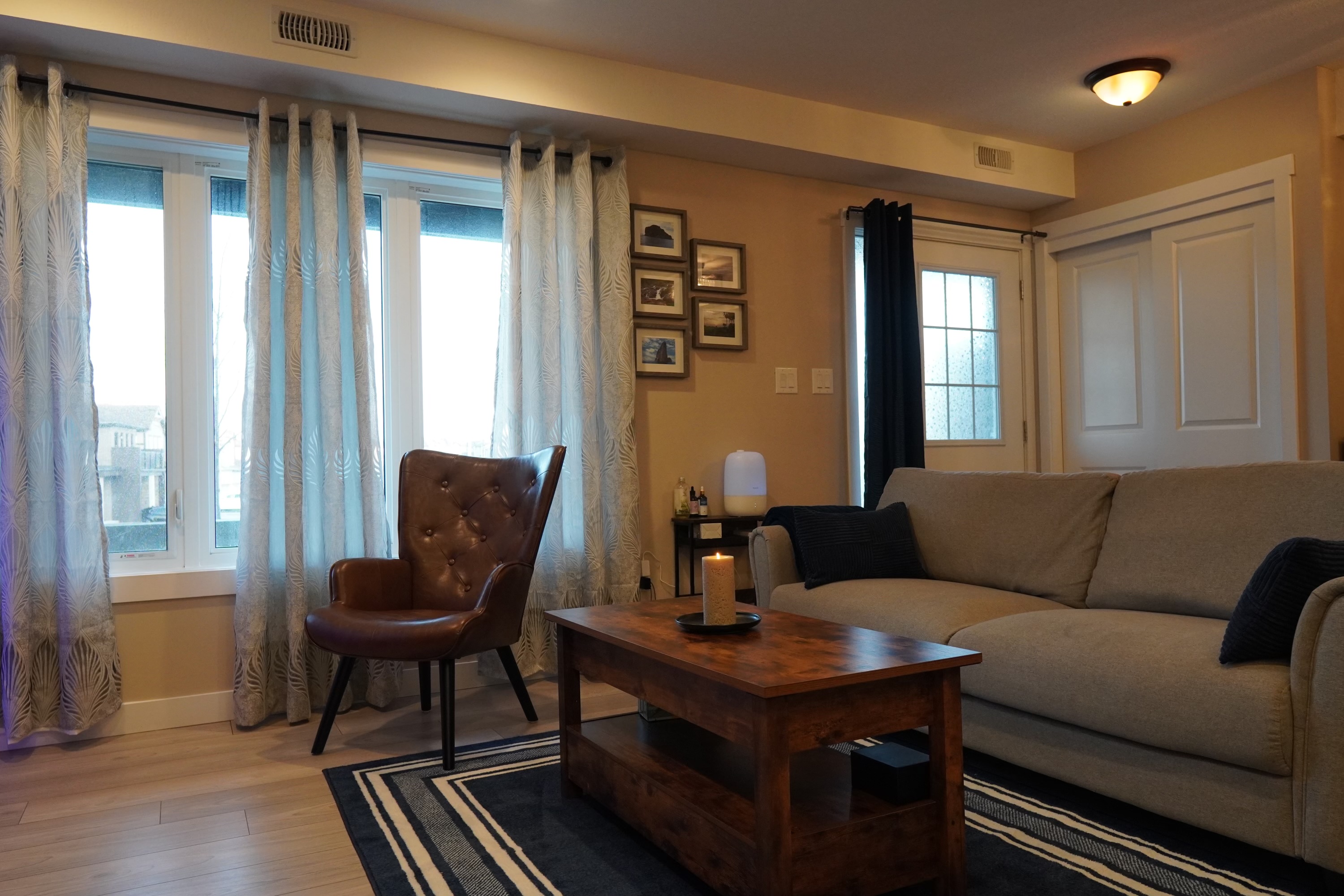
Every room has a battle happening inside it. On one side: the digital pull of screens, notifications, and infinite scroll. On the other: the human need for presence, rest, and genuine connection. Most rooms don't acknowledge this battle. They let the digital side win by default.
When I designed my client's living room, I made a different choice. I created a corner where phones don't belong. Not through rules or willpower—those always fail. Through design.
The analog corner is a space so comfortable, so intentionally crafted for presence, that reaching for a phone feels wrong. The environment itself enforces what discipline cannot.
Why Phone-Free Zones Matter
My client came to me with a familiar problem. He'd sit on his couch after work, intending to relax. Five minutes later, he'd be scrolling. An hour later, he'd still be scrolling. He'd feel worse than when he started, but the phone stayed in his hand anyway.
The problem wasn't his willpower. The problem was his environment. His living room was designed around the television, which was designed around apps, which were designed to keep him staring at screens. Every piece of furniture pointed toward a glowing rectangle. There was nowhere to sit that didn't invite digital consumption.
I gave him somewhere else to sit. A corner with a comfortable chair, a good lamp, and a small side table. No screen visible from that angle. No charging cables nearby. Just space for a book, a drink, and his own thoughts.
The phone still exists. He can still pick it up. But now there's a place where picking it up feels like the wrong choice—because everything about that corner says: be here instead.
Designing the Physical Space
The analog corner starts with furniture placement. I chose a chair that faces away from the television and toward the window. When my client sits there, the screen is behind him. He'd have to turn completely around to see it. That friction is intentional.
The chair itself matters too. I selected something comfortable enough for extended sitting but supportive enough for reading. A chair you sink into and disappear tends to become a napping chair. A chair with gentle structure keeps you alert enough to engage with a book or conversation.
Next to the chair: a side table with enough surface for a mug and a book, but not enough for a laptop. The size constraint is deliberate. This isn't a workspace. It's a presence space.
Lighting was critical. I installed a dedicated reading lamp—warm light, directional, adjustable. When my client turns on that lamp and turns off the overhead lighting, the corner becomes its own little world. The rest of the room recedes. The glow says: you are in the reading spot now.
The Sensory Experience
Good design isn't just about furniture. It's about what you feel when you're in the space.
The analog corner includes texture. The chair has a soft fabric that feels different from the leather couch. The side table has a wood grain that invites touch. There's a small plant in the corner—something green and alive that a screen can never replicate.
These textures matter because phones are smooth and uniform. They offer no sensory variety. The analog corner offers the opposite: warmth, grain, softness, life. When my client sits there, his hands have something to feel besides glass.
There's also no ambient noise associated with the corner. The television's standby hum doesn't reach there. The router's blinking lights aren't visible. The corner exists outside the digital infrastructure of the home.
No Charging Allowed
The most important rule of the analog corner: no charging cables anywhere near it.
This sounds small. It's not. A charging cable is an invitation. It says: your phone belongs here. It provides a justification for having the phone nearby. "I'm just charging it while I read."
Once the phone is there, being charged, it's also there to be checked. One glance becomes five minutes becomes an hour.
I routed all charging to a different part of the room, near the door. My client plugs in his phone when he gets home, then walks away from it. By the time he reaches the analog corner, the phone is already distant. Getting it would require effort. That effort protects his attention.
The Ritual Dimension
Design creates possibilities. Ritual creates habits.
I helped my client develop an evening routine around the analog corner. After dinner, he makes tea. He carries the tea to the corner. He turns on the reading lamp. He sits.
These actions are the ritual. They signal to his brain: screen time is over. Reading time begins.
The consistency matters. Every evening, same sequence. His nervous system learns to anticipate the transition. By the time he reaches the chair, he's already shifting out of digital mode.
Some evenings he reads for an hour. Some evenings he just sits with his tea, looking out the window. Both are victories. Both are presence. Both are what the analog corner was designed to enable.
What He Reads There
My client keeps a small stack of books on the side table. Physical books, not a tablet. This is another deliberate choice.
A tablet is a phone with a bigger screen. It has apps. It has notifications. It has the same infinite scroll, just larger. Reading on a tablet is reading on a device, which means being one tap away from everything else.
Physical books are closed systems. They contain one thing: the book. There's no notification that can interrupt. No app that can tempt. Just pages.
I helped him curate the stack. Nothing too demanding—he reads demanding material all day for work. These books are for unwinding. Essays. Short stories. Things that reward twenty minutes of attention without requiring hours of commitment.
The books rotate, but the stack stays small. Three or four at a time. Too many books would become visual clutter, and clutter is what we're trying to escape.
Results After Six Months
My client reports that the analog corner has changed his evenings. Before, he would spend ninety minutes scrolling and feel agitated afterward. Now, he spends sixty minutes reading and feels restored.
The math is interesting. Less time in the corner than on the phone. Better results by every measure.
He also notices when he skips the corner. If he falls into old patterns—eating dinner on the couch, picking up the phone, disappearing into scrolling—he feels the difference. The analog corner has become his baseline. The phone has become the deviation.
That's what good design does. It resets the defaults. It makes the healthy choice the easy choice.
Creating Your Own Analog Corner
You don't need a large living room to do this. You need:
One comfortable chair, facing away from screens. The angle matters more than the chair's quality.
One good reading lamp. Warm light, directional, able to create a focused glow.
One small surface for a mug and a book. Not a laptop. Not a tablet. Just analog objects.
No charging cables within arm's reach. Put them elsewhere. Make your phone something you have to get up to check.
A small ritual to mark the transition. Making tea works. Changing clothes works. Anything that says: I am entering a different mode now.
Start with fifteen minutes. Sit in the corner. See what happens when there's no screen pulling at you. Notice how your mind responds to the absence.
The analog corner isn't about rejecting technology. It's about creating balance. Every home needs spaces where screens dominate. But every home also needs spaces where presence dominates.
My client's living room now has both. And in the corner where phones don't belong, he's finding something screens can never give him: the quiet experience of being exactly where he is.